Email for more info: info@mspeptidesolutions.com

Tirzepatide is a 39 amino acid peptide that activates the GIP and GLP-1 receptors at the same time. This explainer covers how the molecule is built, what each modification does, and what the SURPASS and SURMOUNT trials reported.
Tirzepatide Explained: The Dual GIP and GLP-1 Agonist
Tirzepatide is a synthetic peptide of 39 amino acids that switches on two receptors at once: the GIP receptor and the GLP-1 receptor. Almost everything interesting about it follows from that one design decision.
If you have not read the background on how GLP-1 works, that is the place to start. This piece assumes it.
Built on GIP, not on GLP-1
Tirzepatide’s backbone is based on the sequence of native GIP rather than GLP-1, which surprises people.
The two hormones are related closely enough that a molecule shaped mostly like GIP can be engineered to fit the GLP-1 receptor as well. So the starting material is GIP, modified until it activates both. That is why tirzepatide is described as a GIP receptor and GLP-1 receptor agonist, in that order.
The three modifications that make it work
Aib substitutions to survive DPP-4
Native incretins are destroyed within minutes by DPP-4, which clips two amino acids from one end. Tirzepatide carries aminoisobutyric acid, written Aib, at positions 2 and 13. Aib is not one of the standard twenty amino acids, and DPP-4 cannot process it. The cut site is effectively disabled.
A fatty acid tail for albumin binding
A C20 fatty diacid is attached through a linker to a lysine residue on the chain. That tail binds reversibly to albumin in the blood.
While the molecule is riding on albumin it is protected from enzymes and too big for the kidneys to filter out, and it comes off gradually. The result is a half life of roughly five days, which is what makes once weekly dosing possible. Without this, the compound would be gone in minutes.
Tuned receptor behavior
Tirzepatide does not hit both receptors equally. It behaves as a full agonist at the GIP receptor and has weaker activity at the GLP-1 receptor compared to GLP-1 itself.
There is a second layer to this. At the GLP-1 receptor it shows biased agonism, meaning it favors one downstream pathway over another. It drives cAMP signaling strongly while recruiting less beta-arrestin. Beta-arrestin recruitment is part of how receptors get pulled off the cell surface and desensitized, so less of it means the receptor stays responsive for longer.
What the GIP half contributes
GIP was the neglected incretin for a long time. Adding it back changes the picture in a few ways.
- Insulin release is stimulated by GIP receptor activation in a glucose dependent way through its own receptor, working alongside the GLP-1 arm rather than duplicating it.
- Fat tissue carries GIP receptors on adipocytes, which are involved in how it handles nutrients and blood flow.
- The brain carries GIP receptors in regions involved in appetite regulation, including areas that also carry GLP-1 receptors.
- Nausea signaling may be dampened too, since research in animals has shown GIP receptor activation reducing nausea responses driven by GLP-1 receptor agonism. That is one proposed explanation for how a stronger compound can be tolerated.
The clinical record
Tirzepatide has been studied in two large trial programs. The SURPASS program looked at type 2 diabetes, and the SURMOUNT program looked at weight management.
In SURMOUNT-1, participants without diabetes received tirzepatide for 72 weeks. At the 15 mg dose, mean weight reduction from baseline was about 20.9%. The SURPASS trials reported reductions in HbA1c, a marker of average blood glucose over roughly three months, alongside weight loss.
The most frequently reported effects across these trials were gastrointestinal: nausea, diarrhea and constipation, generally most noticeable when a dose was increased and easing over time.

Tirzepatide compared with the other compounds
| Compound | Receptors | Half life |
|---|---|---|
| Native GLP-1 | GLP-1 | 1 to 2 minutes |
| Tirzepatide | GIP + GLP-1 | About 5 days |
| Retatrutide | GIP + GLP-1 + glucagon | Multi day |
The pattern is a straight line. Each generation adds another receptor to the same molecule. These act systemically through receptors, which is what separates them from locally placed cosmetic products such as Lemon Bottle. Retatrutide continues it by bringing in the glucagon receptor.
Handling notes
Tirzepatide is supplied freeze dried and needs mixing before use. Standard peptide handling applies: bring the vial to room temperature, run the water down the inside wall rather than into the powder, and do not shake it. The reconstitution guide covers the full process, and storage matters just as much once it is mixed.
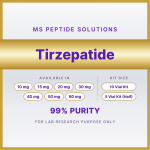
Available here in vial sizes from 10 mg through 30 mg and 60 mg, plus an oral tablet format.
Common questions
What does dual agonist mean?
One molecule that binds and activates two different receptor types. Tirzepatide activates the GIP receptor and the GLP-1 receptor, so a single compound produces effects that would otherwise need two.
Why is it dosed weekly?
The fatty acid tail binds albumin, which protects the molecule and releases it slowly, giving a half life of about five days. At that rate weekly administration keeps levels reasonably steady.
Is tirzepatide a GLP-1?
It activates the GLP-1 receptor, but calling it “a GLP-1” is loose. Its sequence is based on GIP, and it acts on both receptors. Dual agonist is the accurate description.
What is Aib and why does it matter?
Aminoisobutyric acid, a non standard amino acid. Placed where DPP-4 would normally cut, it stops the enzyme from doing its job and keeps the molecule intact far longer.
TL;DR
Tirzepatide is a 39 amino acid peptide built on the GIP sequence that activates both the GIP and GLP-1 receptors. Aib substitutions block DPP-4, and a C20 fatty diacid tail binds albumin to stretch the half life to about five days. It is a full agonist at GIP, weaker and pathway biased at GLP-1, and it has been studied across the SURPASS and SURMOUNT trial programs.
Everything we supply is lab tested for purity and identity, and sold as research grade material for laboratory and research use. See the full GLP-1 and weight management range.
Featured image by liverpoolhls, CC BY 2.0.