Email for more info: info@mspeptidesolutions.com

Nearly every dosing mistake comes from confusing the strength of the solution with the amount you draw. This guide works through the arithmetic, which reduces to a single division, and shows how syringe units map onto milliliters.
Peptide Dosing Math: Concentration and Syringe Units
Nearly every mistake in this area comes down to one confusion: mixing up the strength of the solution with the amount you draw. They are different numbers, and the syringe measures the second one while the label tells you the first.
The math itself is a single division. Here is how it fits together.
The one formula
Concentration (mg/ml) = peptide in the vial (mg) ÷ water added (ml)
That is it. A 10 mg vial with 2 ml of water gives 5 mg/ml. The same vial with 1 ml gives 10 mg/ml. The same vial with 5 ml gives 2 mg/ml.
The amount of peptide never changes. Only how much liquid it is spread through. This is the single most common misunderstanding: adding more water does not give you more material, and adding less does not give you a stronger vial in total. It changes how concentrated each milliliter is, nothing else.

Reading an insulin syringe
The second confusion lives in the syringe markings. A standard insulin syringe is marked in units, not milliliters. On a 100 unit syringe, the full barrel is 1 ml.
- 100 units = 1 ml
- 50 units = 0.5 ml
- 20 units = 0.2 ml
- 10 units = 0.1 ml
- 1 unit = 0.01 ml
Those units have nothing to do with the peptide. They are pure volume markings. The syringe does not know or care what is in it.
So the sequence is always: work out your concentration in mg/ml, work out what volume contains the amount you want, then convert that volume into units.
Worked examples
A 10 mg vial with 2 ml
Concentration: 10 ÷ 2 = 5 mg/ml
Since 1 ml holds 5 mg, and 1 ml is 100 units, each unit holds 5 ÷ 100 = 0.05 mg, or 50 mcg.
To measure 500 mcg: 500 ÷ 50 = 10 units.
A 5 mg vial with 2 ml
Concentration: 5 ÷ 2 = 2.5 mg/ml
Per unit: 2.5 ÷ 100 = 0.025 mg, or 25 mcg.
To measure 250 mcg: 250 ÷ 25 = 10 units.
A 50 mg vial with 2 ml
Concentration: 50 ÷ 2 = 25 mg/ml
Per unit: 25 ÷ 100 = 0.25 mg.
At this concentration a single unit carries a fairly large amount, which means small errors in reading the syringe translate into large errors in what you measured. Adding more water would spread the same 50 mg through more volume and make small amounts easier to measure accurately.
Reference table
What one unit on a 100 unit syringe contains, for common combinations.
| Vial | Water added | Concentration | Per unit |
|---|---|---|---|
| 5 mg | 1 ml | 5 mg/ml | 50 mcg |
| 5 mg | 2 ml | 2.5 mg/ml | 25 mcg |
| 5 mg | 3 ml | 1.67 mg/ml | 16.7 mcg |
| 10 mg | 1 ml | 10 mg/ml | 100 mcg |
| 10 mg | 2 ml | 5 mg/ml | 50 mcg |
| 10 mg | 3 ml | 3.33 mg/ml | 33.3 mcg |
| 20 mg | 2 ml | 10 mg/ml | 100 mcg |
| 50 mg | 2 ml | 25 mg/ml | 250 mcg |
mg and mcg
The milligram to microgram conversion is worth stating plainly, because errors here are the expensive kind.
1 mg = 1000 mcg. A thousandfold difference. Protocols in this area are often written in mcg while vials are labeled in mg, so the conversion happens constantly and a misplaced decimal is a factor of ten in either direction.
Get in the habit of converting everything to one unit before doing any arithmetic, rather than switching between them mid calculation.
Choosing your reconstitution volume
Since the volume is your choice, choose it deliberately.
More water, weaker solution. Small amounts become easier to measure accurately because they occupy more units on the syringe. The tradeoff is more volume per measurement and the vial fills up faster.
Less water, stronger solution. Compact, but small amounts land in the first few units where reading accuracy is worst.
A reasonable rule: pick the volume that puts the smallest amount you need to measure somewhere in the 10 to 30 unit range. That is comfortably readable on a standard syringe and leaves room for error in both directions. Also remember that a mixed vial has a shelf life, so there is no point diluting to a volume you cannot get through.
One thing the label does not tell you
Freeze dried material contains some residual moisture and often salt left over from purification. The mg on the label refers to peptide content, but total powder mass in the vial can be slightly higher.
For most work this is not significant, but it is one reason the figure on a certificate of analysis and the number you calculate from the label are not always the same thing.
Common questions
How many units is 1 ml?
On a standard 100 unit insulin syringe, 1 ml is 100 units. Each unit is 0.01 ml.
Does adding more water reduce how much peptide I have?
The amount in the vial is fixed, so water changes only the concentration, meaning how much sits in each milliliter. The total is unchanged.
What is the standard reconstitution volume?
There is not one. It is your choice, and it should be driven by the smallest amount you need to measure accurately. 2 ml is common because it produces convenient numbers with typical vial sizes.
Why do protocols use mcg when vials are labeled in mg?
It is a convention that keeps the numbers readable. Vials are labeled in mg because that is a sensible size for the quantity present, while the amounts measured out are often small enough that mcg avoids leading zeros. 1 mg is 1000 mcg.
TL;DR
Concentration equals mg in the vial divided by ml of water added, and that is the only formula involved. On a 100 unit insulin syringe, 100 units is 1 ml and 1 unit is 0.01 ml, so per unit you get concentration divided by 100. Adding water changes concentration, never total quantity. 1 mg is 1000 mcg. Pick a reconstitution volume that puts your smallest measurement in the 10 to 30 unit range.
The mixing procedure itself is covered in the reconstitution guide. Everything we supply is lab tested for purity and identity, and sold as research grade material for laboratory and research use. Solvents and syringes are in the supplies range.
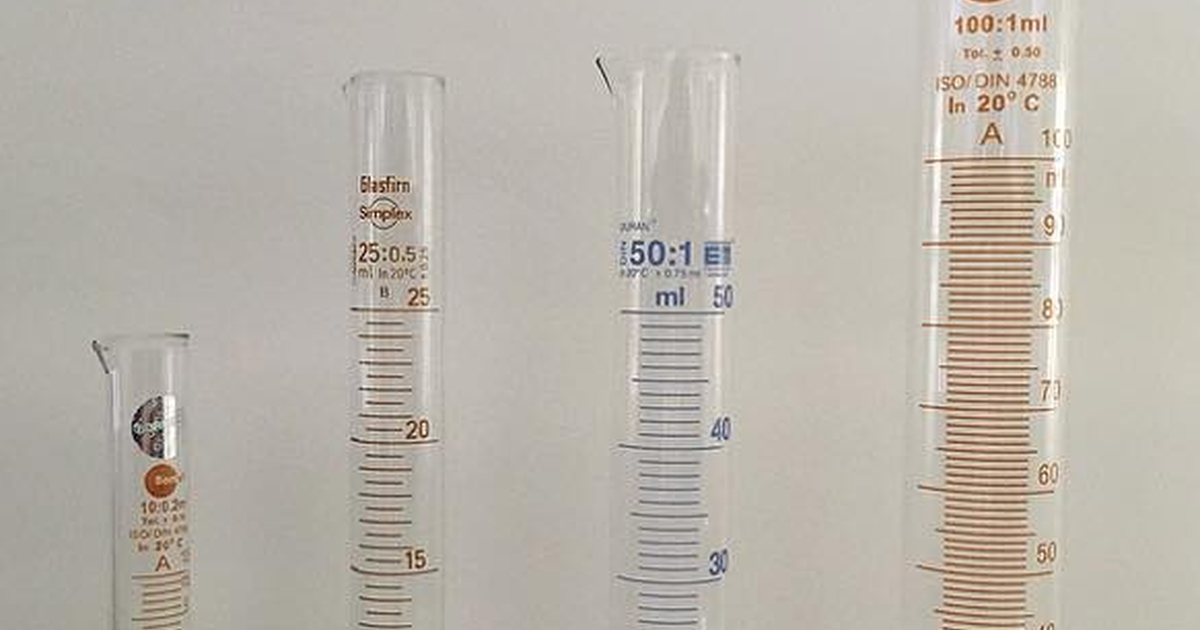
Featured image by Praphai Donphaimueang, CC BY-SA 4.0.